

Friends.
A while back I created a canvas of “Tom and Jerry”. Do you remember it? I called it “Keep Chasing the Cheese”.
That crazy Jerry Mouse, am I right? That dude cannot NOT stay away from his cheese. It doesn’t matter what sort of trap is set or how far he has to run, jump, etc. … he will do anything for the cheese. The idea I presented with the piece was that we would do well to chase the cheese in our lives.
Not money.
Not possessions.
Not stature.
Not fame.
Not likes.
BUT.
The “cheese” of our True Selves - the very heart of who we are. For me, that’s the cheese - that’s the thing I chase after these days. I want to be “healed”, I want to be “well”, I want to live a life of love and grace and compassion and peace like the very force that created me, the very Divine Energy that (I believe) we are all a part of.
Anyways.
This “Keep Chasing the Cheese” piece sat in my office for the longest time and I realized I didn’t like the background color and I didn’t like the proportions - Tom’s arm that is dangling the cheese felt too small in comparison to Jerry who should be significantly smaller (since he’s a mouse!).
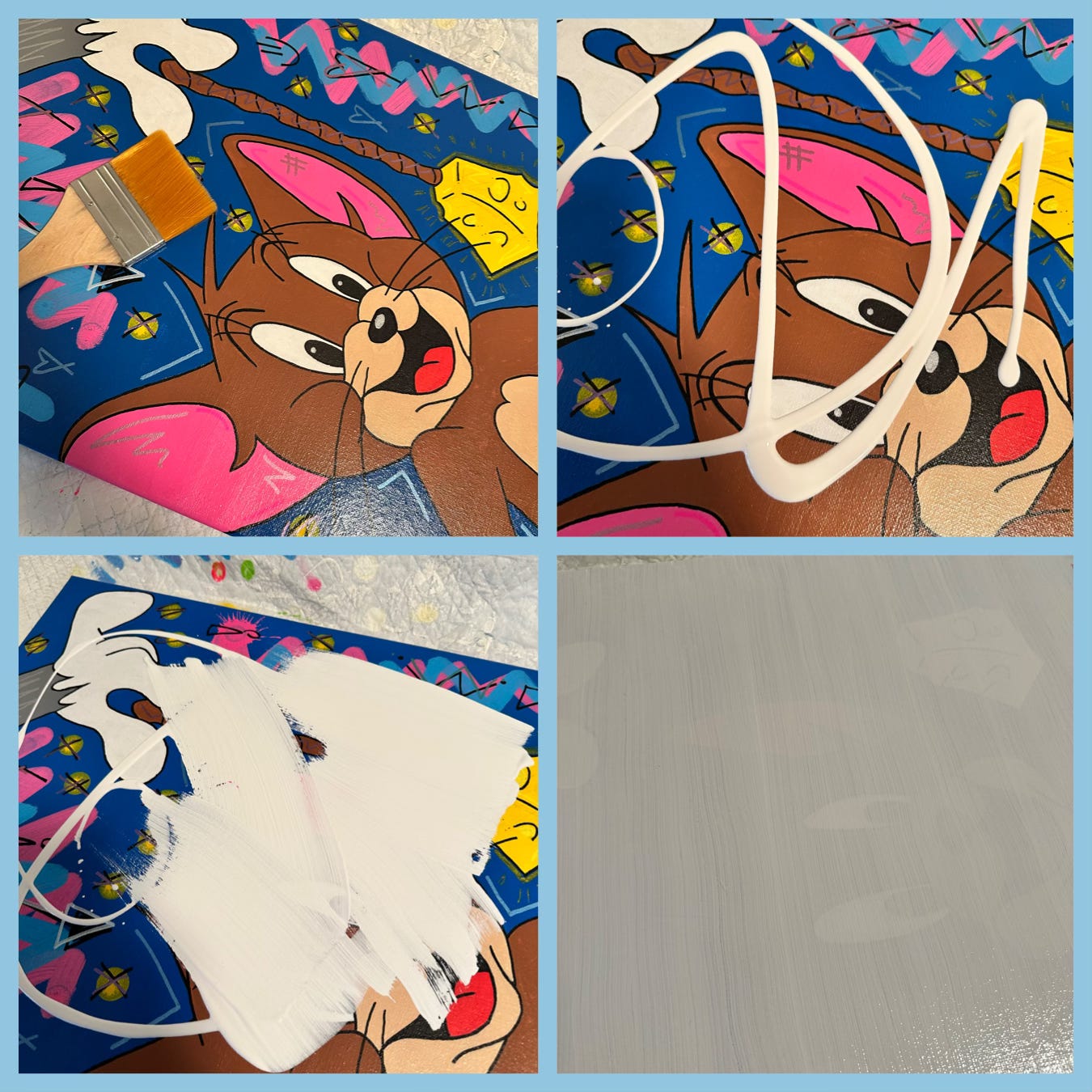
And so, I decided to “begin again”. I got out my brush and my primer and I primed over a piece of art that took me a couple of weeks to make so that I could do a different “Tom and Jerry” piece that I’ve had in mind for a while.
Yes: “begin again”. This is a phrase that comes from the world of “mindfulness” and “meditation” that I love.
I’ll get back to the paitning in a minute.
(I promise this has a point.)
The idea behind “begin again” is that when you’re sitting in a time of meditation and are working to focus on your breath or a particular sound (or whatever “anchor” you might choose to tie your attention to for those minutes), your mind will wander - a very normal thing to happen. The goal, however, isn’t to eliminate your thoughts (that’s impossible, after all); instead, the goal is to recognize when the mind wanders, be aware of the thoughts, and then “begin again” by bringing your attention back to your breath or whatever your “anchor” might be for that particular mediation time.
And this?
This is an excercise for the brain - the brain likes to think, it likes to wander; it likes to remind you of the to-do list, to remind you of what you need at the grocery store, to relive that past event or wonder about tomorrow’s meeting at work. In other words, when you try to focus it on any one thing, it likes to remind you of all the other things you could be focusing on in this moment.
Phew.
The more we meditate, though, and practice “mindfulness”, the more we train our mind to focus on one thing and the more we become aware of the thoughts in our minds that quite often operate on auto-pilot - bringing us thoughts and visions that we (sometimes) aren’t even aware that we’re having and maybe don’t even want to have! And so meditation helps us become more aware of the thoughts in our mind and see them from an elevated point of view where we come to realize that we aren’t our thoughts and (therefore) can become aware of our thoughts or observe our thoughts from afar, giving us the power to decide which ones we want to act on.
Said differently …
We come to a place where we observe our thoughts as separate from ourselves and then choose how to respond TO those thoughts instead of immediately repsonding FROM them.
In her book “Real Happiness”, meditation teacher Sharon Salzberg says it like this,
“Most of the time we think we are our thoughts. We forget, or have never noticed, that there’s an aspect of our mind that’s watching our thoughts arise and pass away. The point of mindfulness is to get in touch with that witnessing capacity. Sometimes I ask my students to imagine each thought as a visitor knocking at the door of their house. The thoughts don’t live there; you can greet them, acknowledge them, and watch them go. Mindfulness practice isn’t meant to eliminate thinking but rather to help us know what we’re thiniing when we’re thinking it.”
Perhaps an example will help?
For me (and I’ll be vulnerable with you here) - mindfulness meditaton has helped me become a better parent. Because parenting is hard, amen? And sometimes our kids will push our buttons, which can easily cause us to say things or act in ways that we will later regret.
I can’t tell you how many times (especially over the Summer when Jordan is off of school and I’m working from home) that I have become impatient with Jordan and snapped at her, only to later apologize for my lack of patience.
And this?
It’s a never-ending cycle of regret, right? Because I’m working from home and Jordan is home and every day there is more work to do, another to-do list to complete for clients, my podcast, etc.; and although I might apologize for how I responded in frustration one day, the reality is that the next day will hold similar frustrations that bring about similar feelings and thoughts inside of me. And if I’m unaware of what is happening inside of me? Then I’ll just continually respond in frustration which will (later) cause me to feel more guilt and more shame.
Sigh.
Have you been there?
Meditation, though, has really helped me. I’m far from perfect, but I’m now able to pause before I respond. Rather than think, “I have so much work to do” and then respond from that thought by snapping at Jordan or letting out a loud sigh when she asks me for something after (literally!) just getting her something 3 seconds earlier … I pause.
Yes:
I pause.
I recognize that I’m feeling frustrated.
(NOTE: that’s key, by the way - a helpful reframe. I didn’t say, “I am frustrated”; instead, I said, “I’m feeling frustrated.” Right? I’m not “frustrated” - frustration is not my identity, it’s not who I am. Rather, I’m a good person, a good father who is experiencing a moment of frustration.)
I observe all the thoughts that are swirling around that cloud of frustation.
I recognize that Jordan isn’t trying to be difficult.
I recognize that I can speak kindly to her.
I recognize that I will get my work done regardless of whether she’s home or not.
I take a deep breath.
And then.
I choose how to respond; and instead of responding shortly or snapping at her (responding FROM the frustration), I respond more kindly (from my True Self) - “hey, I would love to do that with you … but I can’t at this moment. Can I have 30 more minutes to finish this thing for Bart or Alexander or my podcast and then I promise we’ll have a block of time to play?”
Ah, yes. A much better approach, right? In this example, I recognized the thoughts that I was having as separate from my True Self and instead of simply responding from them, I responded (instead) from the heart of my True Self - a being of complete love and kindness and compassion.
And so, “begin again” - for me, it’s a phrase that sort of wipes the slate clean both in a time of meditation (when the mind wanders away from it’s anchor) and in life when we fail to recognize our thoughts, fail to respond from our True Self, and (instead) respond from a place of anger or frustration or whatever thoughts might be swirling around in our head at the time.
Back to my example - if I get carried away in my frustration and snap at Jordan, I can become aware of what I did and apologize: I can “begin again”.
I can wipe primer over what just happened, I can admit that I was wrong, I can ask for forgiveness, and I can try better next time.
And then the next time I might do better - I might be aware of my thoughts and respond from a place of kindness like the example above.
And I might do that the next time.
And the time after that!
BUT.
Then on a day when I have a lot to do and my nervous system is in knots, I might respond in frustration again only to realize (later) what I did, apologize, and begin again.
Begin again.
Begin again.
Begin again.
And the more I do this? The more I “begin again”? Well. Then the less I will find myself being carried away by my thoughts, the more aware I will become, the more I will be able to observe my thoughts instead of being carried away by them.
And so after “beginning again” with my painting, here is the final product:
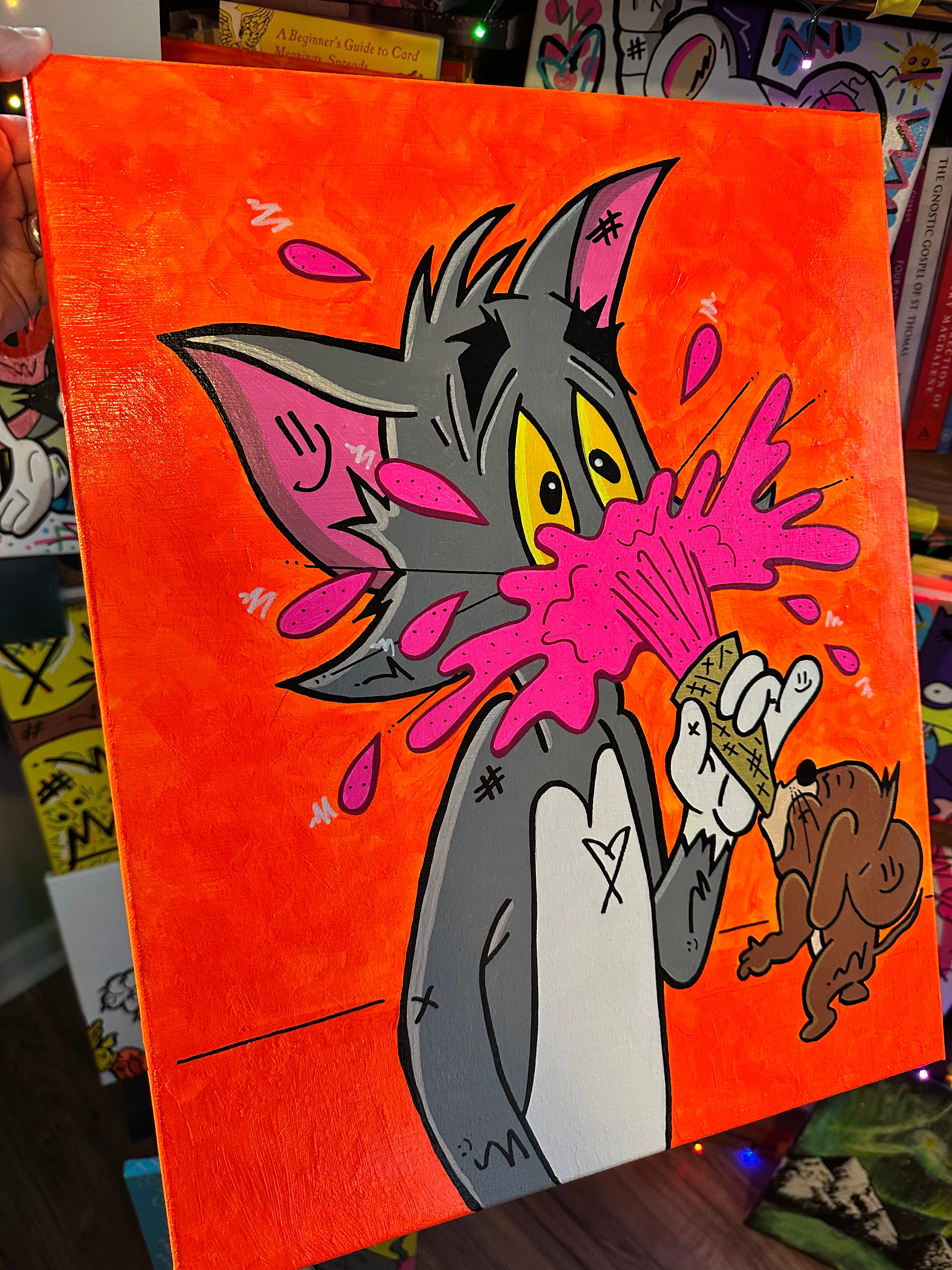
Much like meditation and learning to “begin again” has added some color and life and light to my parenting, I feel like beginning again with “Keep Chasing the Cheese” made a much colorful painting, right? Jerry is the perfect size in comparison to Tom, the colors are brighter, the concept better captures their personalities, and I feel immensely better about it than I did the other.
Yeah - this one really makes me smile.
“Begin again”. Where might you need to apply some of these ideas to your own life? I have a meditation app called “Happier” where there is a library of guided meditations to help with the very things I described above. As a member I can give out free passes to people and so if you’d like one just let me know and I’ll send you the invite.
Much love.
Glenn || SUPPORT / ART STUDIO
PS - want this “Begin Again” piece that I made? Just message me an offer (even $0!) and I’ll drop it in the mail next week. It’s a little bit bigger, 16x20 - perfect piece to brighten up a room!