
Hello Friend,
Welcome to Lectarot Divina - a space where I’m sharing some of my spiritual practice with you, showing how my lifelong love for the stories of Jesus is making space for my newfound love for Tarot.
Can these 2 things (that many of of us have been told are OPPOSITES) actually get along?
Can they make space for each other?
Play nice together?
Dance with each other?
Inform each other?
… I think so; and so a few mornings a week I read from my Bible and pull a Tarot Card and am amazed (almost every time!) how each of them informs the other, inviting me to eavesdrop on their beautiful conversations that leave me inspired, bewildered, and amazed.
In this series of essays or thoughts or posts or whatever we want to call them, I want to begin writing out some of the ideas that erupt from these stories and card pulls because although I jot things down in a journal, sometimes I feel like I have more to get out of me and so this felt like a good space to do that in … a space that may or may not one day turn into a book of sorts.
Anyways, each entry in this collection will look at the Gospel story from that week’s Lectionary reading along with a Tarot Card that I will pull at random and then we’ll spend the post exploring each and wondering how they might be working together to deepen our insight into the Divine.
Ready?
Here we go …
This week’s Lectionary Gospel: Matthew 21:33-46 (← click the link to read the passage in the NIV)
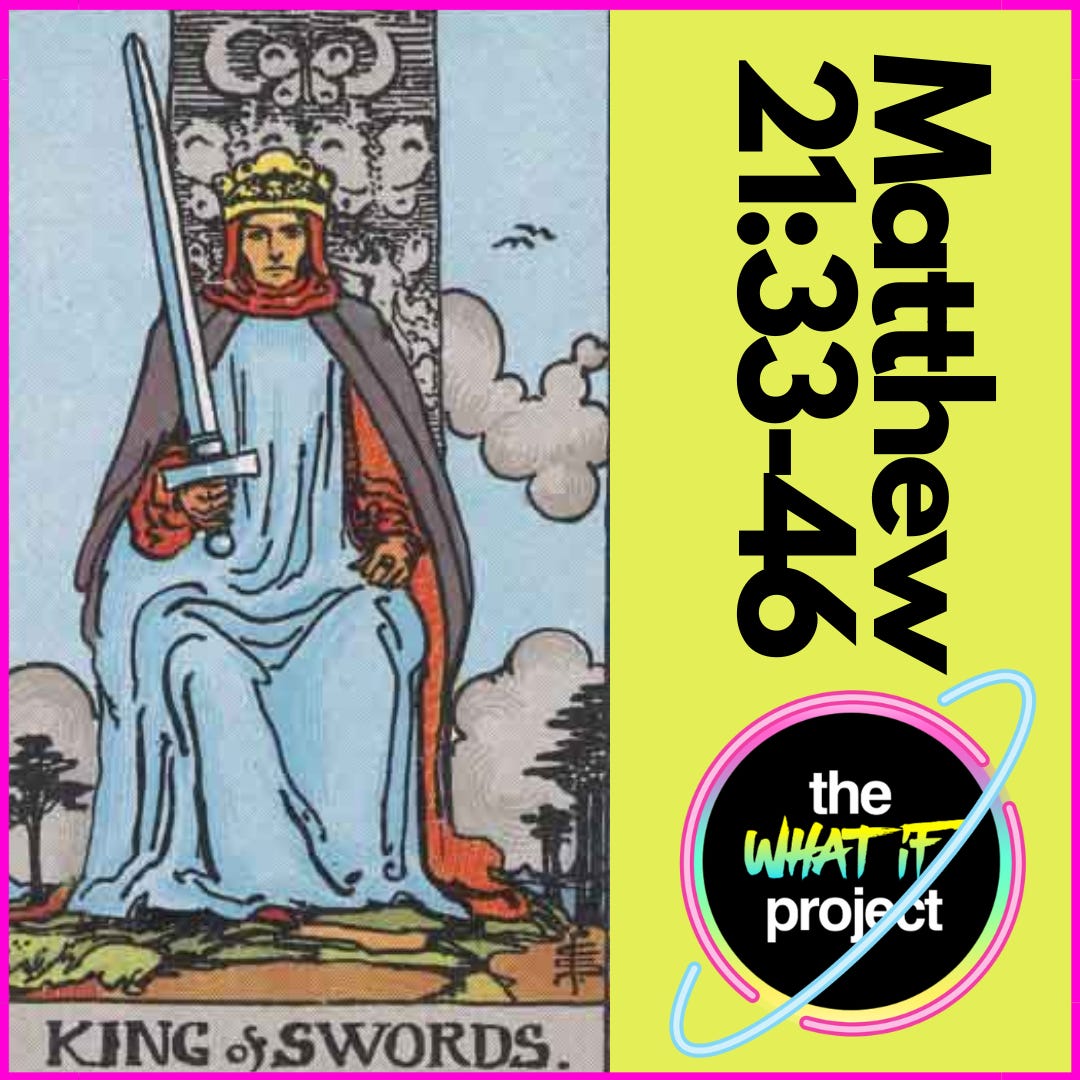
Tarot Card (pulled at random): King of Swords
There comes a time in everyone’s life where they must decide to follow their gut, to follow the deep inner voice that steers them and directs them and tells them what to do.
(We’ll come back to that in a moment.)
In Matthew 21 Jesus tells a parable about a landowner who planted a vineyard and leased it to some tenants before heading out to another country. Time went by, Jesus says, and when harvest time arrived the landowner sent one of his workers to collect the goods.
What happened next, you ask?
The tenants seized the workers - beat one, killed another, and stoned a third. Didn’t see that coming, did you? Apparently neither did the landowner!
Oddly, the landowner sent more workers (I say oddly, because … why send more people if they killed the first set of people you sent?!), but the tenants (shocker!) did the very same thing - killed them.
PAUSE.
Can you imagine the absurdity of this? Like, really? You rent a piece of land from someone and when they send their workers to pick up the items that are rightfully theirs …
Crops grown on his land.
A boat he left in his backyard.
A spare car he left in his garage.
… you kill them?
Eh? Bizarre, to say the least.
And so finally, Jesus says, the landowner sent his son (thinking the tenants would treat him own flesh and blood with some respect), but the tenants saw it as an opportunity to steal his inheritance and so they grabbed him, threw him off the land, and killed him too.
The people who Jesus is telling the story to (the Pharisees) go absolutely bonkers and are like, “O.M.G., the landowner will most certainly see to it that those tenants have a slow, miserable, painful death.”
Jesus then quotes an obscure verse from the Old Testament Scriptures,
“The stone that the builders rejected has become the cornerstone; that was the Lord’s doing, and it is amazing in our eyes.”
Hm.
And then he goes on to say that “the Kingdom of God will be taken away from YOU (the people he’s talking to!) and given to a people that produces the fruits of the Kingdom.”
I always hated this story, to be honest, because I’ve heard it used a bazillion times to shame and ridicule Jewish people - the (supposed) “tenants” of the story who killed the workers/prophets that God sent to help them and would (soon in the story) kill God’s own Son, Jesus. Yeah, “those terrible Jews.”
Ugh.
I mean.
Do I even HAVE TO explain what awful theology that is? The Jews didn’t kill Jesus, the Empire did. Yes, a small group of Jewish Leaders might have been in on it in some way shape, or form … but that small group is in no way representative of the entirety of Judaism. Right? I mean, that’s like saying that all Christians are …
Rapists.
Cheats.
Liars.
Self-Absorbed.
Narcissistic.
… Because of the handful of big named pastors who have been caught in their own webs of sin and deceit and lies.
“They’re like that so ALL CHRISTIANS must be like that too.”
Ridiculous, right? I’m not them. You’re not them. And yet we’ve been taught to act as if ALL JEWS are that small group of Ancient Jewish Leaders who may (or may not) have partnered with the Roman Empire to have Jesus executed.
Anyways, and so I really don’t like this story because I have a hard time reading it apart from that (awful) theology that I was given growing up in Private Christian School, Bible College, and even a bit in seminary - “those silly Jewish people couldn’t live up to their calling as ‘God’s Chosen People’ so much so that they killed God’s only Son; and so God had to give the vineyard to someone else … us, the amazing and oh-so-wise Christians, the ones who have accepted and welcomed and made space for God’s Son. Praise God for US!”
Yuck.
Today, though, I decided to give the story another go and sit with it until I saw something different; and after a few read-throughs I began to notice the word “cornerstone” jumping off the page.
Now.
I should note that these days I’m reading the stories of Jesus less and less and less as pieces of theology and more and more and more as stories that are meant to strike my soul and awaken something in me that’s sleeping, that I’ve forgotten about. Whereas I used to read the stories of Jesus to build a solid “Christology”, today I read them to better understand myself. After all (as I’ve said elsewhere) Jesus is (for me) a mirror that reflects myself back at me. In other words, when I forget who I am or lose my way or feel “off” on the inside … I stare at the stories of Jesus until I remember who I am, until I wake up, until I begin (again) living as the person I was created to be, the person I know I can be.
And so today this word “cornerstone” jumped off the page …
“The stone that the builders rejected has become the cornerstone.”
… and as I meditated on it I began to think about my own life and I began to ponder how for the longest time I rejected that inner voice of knowing, that inner voice that I mentioned at the beginning that has a knack for steering and directing and whispering and telling me what to do. I got to thinking about the countless YEARS that I stuffed that voice away and kicked it off the land of my heart in an effort to make room for theology and doctrine and certainty and all the things that made me an amazingly great Fundamentalist Christian.
The voice would whisper, “are you sure there’s a hell? Doesn’t the seem a bit … idk … off?” and the Fundy Soldier inside would bark back, “OF COURSE THERE’S A HELL - READ YOUR BIBLE AND SHUT UP.”
The voice would whisper, “God allows rape? Molestation? Murder? And yet is all-powerful? You sure about that? How does that make even a shred of sense?” and the Fundy Soldier would scream, “HOW DARE YOU QUESTION THE ALMIGHTY! GOD’S WAYS ARE NOT OUR WAYS - WHERE IS YOUR FAITH?!”
That small voice would whisper stuff like that to me all the time about various topics like sin and death and heaven and hell and the Rapture and Original Sin, but the other voice would always rise up out of the text books on my desk and beat it into submission - throw it off the vineyard, if you will, and … kill it.
And so Jesus says that this stone (this stone that has been rejected) has now become the cornerstone and …
I mean.
… Yeah. Right? That small, inner voice that I rejected for so long and that I stuffed away and that I tossed off the land of my heart and all but crucified - that voice has now become my cornerstone. I’ve taken some leaps of faith away from the faith of my youth and have embraced the stone that I once rejected, made space for the voice I once silenced, enthroned that voice in the center of my being.
And this is the meaning of the King of Swords, I think. The King of Swords sits on a throne with a sword in his hand. He’s confident, he’s calm, he’s cool, he’s collected.
AND.
He knows who he is listening to and who he’s not listening to. He knows that he has little time to hear from the voices that might scream at him from the outside, telling him what to do and how to act … and he realizes that the only voice that really matters is the one within that whispers thoughts and advice and intuition and helps navigate him and guide him through the challenges and the conflicts of his life. That voice, the King knows, is the one that ought not be rejected - the cornerstone voice that ought to be given space and enthroned in the very center his being.
Friends.
What voice have you rejected in the name of certainty? What inner voice have you shoved away and pushed down so that you could jam pack your heart with the theologies and doctrines and ideas that you were told you had to believe?
What questions have you silenced?
What doubts have you locked away?
What whispers have you dragged off into the night to have killed?
Hm.
Perhaps the time has come for that rejected stone to be made the cornerstone, for you to carry that voice back into the land of your heart and seat it on the throne of your heart where it can whisper its wisdom and guidance and direction and lead you …
Deeper.
And deeper.
And deeper.
And deeper.
… into the heart of the Divine, the place where you will continue to discover more and more and more of who you really are.
Is that helpful? I don’t know. It is for me, I hope it is for you.
Much love,
Glenn || SUPPORT